Yesterday, the House passed by voice vote, a provision that would open all VA facilities to various types of assistance dogs. Currently, only seeing-eye dogs are allowed entry into VA facilities. AMVETS Legislation Department has diligently championed this cause as it will make life much easier for our veterans who rely on these service dogs for improved quality of life.
Here is an excerpt from the Army Times article by staff writer, Rick Maze about this positive step forward:
The Veterans Affairs Department soon could be going to the dogs after a key House vote Tuesday to expand the types of assistance dogs allowed in VA facilities.
VA service-dog regulations, last changed in 1985, guarantee access to only seeing-eye dogs. Other canines trained to help with mobility, hearing impairment, seizure disorders or post-traumatic stress or other mental illnesses are allowed onto VA facilities only by local policy, which is inconsistently applied.
“As a result of current regulations, disabled veterans may be denied entrance to VA medical facilities if accompanied by their VA-approved service dog,” the House Veterans’ Affairs Committee said in an Oct. 5 report about why the change is needed.
AMVETS bill, S. 769 (VETS Dogs) is scheduled for committee markup TODAY at 11 am. Please call your Senator and let them know you support removing any barrier to care disabled veterans experience.
Last week VA Chief of Staff John Gingrich sent a letter to AMVETS outlining VA's plans to enact a new directive that would allow veterans utilizing service dogs as prosthetic devices access to VHA facilities.
The target date for all VHA directors to implement new policies is June 30, 2011.
Under the directive--which expires in March 2016--VA facilities must create new policies allowing veterans who utilize VA-sanctioned service dogs for physical disabilities the same access afforded to seeing-eye and guide dogs.
In the past veterans like AMVETS members Kevin Stone and Sue Downes have been denied access to VA facilities while accompanied by their service dogs Mambo and Leila. Meanwhile, both Stone and Downes receive VA compensation for the proper upkeep of their service dogs, which assist with mobility and independence for both veterans, who sustained serious injuries in the line of duty.
In response to the letter, AMVETS Acting Legislative Director Christina Roof sent a reply to Gingrich, applauding VA's efforts, but clarifying that AMVETS must continue to pursue a permanent legislative solution to the access issue through the Veterans Equal Treatment of Service Dogs Act, or VETS Dogs Act, which was introduced in the House by Rep. John Carter, R-Texas, during the recent LZ:DC, and subsequently introduced in the Senate by Sen. Tom Harkin, D-Iowa.
"AMVETS sincerely appreciates your personal attention to the issue of access to VA facilities for disabled veterans utilizing service dogs as prosthetic devices," said Roof in her letter to Gingrich. "However, AMVETS still maintains that the new VA directive is only a temporary solution to ensuring disabled veterans access VA facilities."
In the letter, Roof clarified that the legislative solution was not an attack on VA or on Gingrich, who gave personal attention to the veterans' service dog issue last summer during AMVETS National Convention, but rather a prudent course of action to ensure that VA policy toward service dogs does not change in the future.
The House and Senate committees on Veterans Affairs intend to address the VETS Dogs Act in the coming months, and Roof said she invites VA's insight on the potential regulation change, when that time comes.
American Veteran will continue to follow the VETS Dogs Act closely. Check back regularly for updates.
To learn more about the VETS Dogs Act, Click Here.
To see video of the press conference announcing the VETS Dogs Act, Click Here.
(Images: Top: Letter from VA Chief of Staff John Gingrich to AMVETS addressing health care access for veterans utilizing service dogs. Bottom: AMVETS' response to the Gingrich letter.)
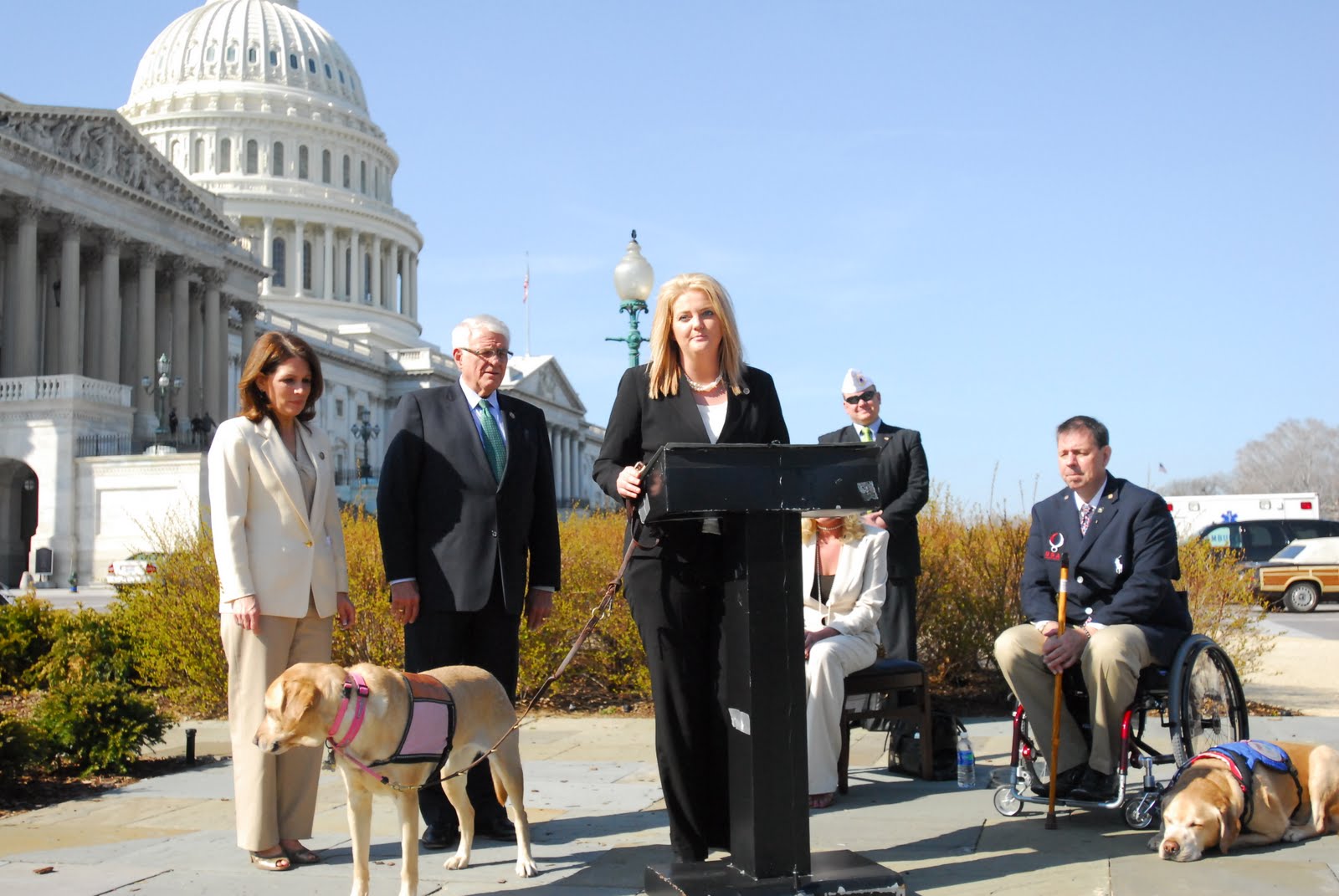
Yesterday afternoon, AMVETS joined Rep. John Carter, R-Texas, and Rep. Michele Bachmann, R-Minn., for a press conference to announce the Veterans for Equal Treatment of Service Dogs Act, or VETS Dogs Act, which Carter introduced in the House of Representatives on Thursday morning.
Here is AMVETS' video of yesterday's announcement, which took place as part of AMVETS LZ:DC:
During the press conference, Carter said that in only two short days since issuing a "Dear Colleague" letter, seeking support for the bill, he had already signed on more than 30 cosponsors from both sides of the aisle--and he was yet to approach the Texas Congressional delegation, or the many caucuses to which he belongs.
"This is a bill whose passage I believe will draw very little debate," Carter said. "This is a rare opportunity to do a great thing for our disabled veterans that adds nothing to the federal deficit, simply by eliminating unneeded and unjustified regulations.
When Congress adjourned from its afternoon votes, random members--some of whom had already signed on to support Carter's bill--consistently stopped by the press conference on the House Triangle to thank veterans Kevin Stone and Sue Downes, who were on hand with their service dogs, Mambo and Lila, to discuss what the legislation will mean for veterans.
VetsFirst, a program from the United Spinal Association, and Paws With A Cause joined AMVETS to applaud Carter and Congressional cosponsors for submitting the bill, which would close a loophole in VA policy that has caused some veterans who utilize service dogs as prostheses to be denied care at certain VA health care facilities.
Stars & Stripes was on hand to cover the announcement. To read the Stripes' coverage, Click Here.
To read Military Times coverage of the bill, Click Here.
To read AMVETS' official statement on the bill roll-out, Click Here, and check back regularly with American Veteran for updates from the LZ.
(Images: Top: Rep. John Carter, R-Texas, discusses the VETS Dogs Act during a press conference outside the U.S. Capitol Building while cosponsor Rep. Michele Bachmann, R-Minn., and AMVETS Sue Downes and Kevin Stone look on. Middle, Left: Kevin Stone pets his service dog, Mambo, while explaining his experiences and why the VETS Dog Act is important to him. Middle, Right: Sue Downes explains why the bill is important to veterans, with her service dog, Lila, by her side. Bottom: Rep. Michele Bachmann shakes hands with Stone and Downes, thanking them for their service and their advocacy for veterans. Photos by Luis Jimenez.)
AMVETS National Deputy Legislative Director Christina Roof and AMVETS partners Paws With A Cause are in Phoenix this week to participate in the Veterans Health Administration’s Prosthetic and Sensory Aid Services Guide Dog and Service Dog Clinicians Training Conference.
The weeklong seminar brings together industry experts within the VA system, veteran service organizations, representatives from the assistance dog industry, and veterans who utilize service dogs to learn about the many benefits of service dogs in the lives of veterans living with disabilities.
VHA's Office of Prosthetic and Sensory Aid Services, or PSAS, put together the conference to inform clinicians about guide dogs and service dogs for veterans, establishing the expertise VA needs to draft clinical practice recommendations for PSAS guide and service dog benefits.
“The overall goal of rehabilitation is to increase or maintain veterans at the highest level of functioning possible. The provision of individualized care leads us to explore and apply, as appropriate, all options to maintain independence as long as possible,” said Stanlie Daniels, deputy chief for the VHA Office of Patient Care services. “Our collaboration with guide and service dog organizations is a key component to assuring we are aware of all options to assist our nation’s veterans.”
For the last two years, AMVETS has aggressively advocated for equal access to care and benefits for veterans utilizing service dogs, working closely with PSAS officials on how to best implement proper policy changes.
Alongside 22-year partner Paws With A Cause, AMVETS views this conference as a critical step in ensuring clinicians understand the benefits of assistance dogs in an effort to ensure proper and equitable access for all veterans utilizing the unique prosthetics.
(Image: AMVETS National Deputy Legislative Director Christina Roof and Deputy Chief of VHA Office of Patient Care Services Stanlie Daniels at the PSAS Guide Dog and Service Dog Conference in Phoenix. Photo courtesy of VHA. Story with contributions from Deb Davis.)
Yesterday, AMVETS Executive Director Jim King sent a letter to VA Secretary Eric Shinseki, asking the secretary to close a critical health care loophole for veterans utilizing service dogs.
Last year, through extensive work advocating for veterans who use service dogs as prosthetic devices for physical injuries, AMVETS Deputy Legislative Director Christina Roof discovered that VA medical centers around the country are not only exempt from the Americans with Disabilities Act, or ADA, but that each medical center was allowed to dictate its own policies toward service dogs.
In two instances, AMVETS members who needed the assistance of their service dogs to make it to their VA appointments were denied care based on the antiquated VA policy that only provides concessions for seeing-eye or guide dogs in VA facilities.
VA already acknowledges that service dogs certified through a doctor's authority to assist with physical disabilities are to be considered prosthetic devices, allowing veterans to receive compensation for regular maintenance.
Last year, AMVETS successfully worked with VA to start properly processing claims for these prosthetic benefits when Roof discovered the access loophole.
AMVETS has attempted to work through proper VA channels to remedy this oft-overlooked policy to ensure that veterans who need their service dogs would not be turned away for care, but Roof said that proper channels have not yielded results, which is why King decided to bring the issue to the attention of Shinseki.
AMVETS is also rallying support for the issue within veterans' advocacy circles, with many partners on The Military Coalition volunteering to send similar letters in the coming days.
AMVETS leaders encourage concerned veterans around the country to use King's letter as a model and send letters of their own to VA and to representatives in Congress.
"A strong, unified voice from the veterans community is the only way to effect positive change," said Roof. "This is the best way for our nation's leaders to see how serious these issues are."
American Veteran will continue to follow the issue closely, and Roof said she will continue to push for equal access for all veterans utilizing VA-sanctioned prosthetic devices like service dogs.
(Image: Official letter from AMVETS National Executive Director Jim King asking VA Secretary Eric Shinseki to close a loophole for veterans' service dogs.)
View the latest issue of American Veteran magazine
Click here
Visit the official Web site of AMVETS
Visit AMVETS on Facebook
Follow AMVETS on Twitter
@AMVETSNational
See AMVETS on YouTube
Join AMVETS Today
Contributors
Andrew Keirn, National Publications Editor, Marine Corps veteran
Leave Your Comments
We're always eager to hear what our readers have to say about the stories in American Veteran magazine and on the American Veteran blog.
If you would like to leave a comment, but would prefer to not sign up for a Google account, simply type in your comment in the "Comment" box at the bottom of each posting, click on the box next to "Comment As" and select "Anonymous."
If you would still like us to know who you are, just include your name at the bottom of your comments and feel free to let us know which AMVETS post or department you're from.




 Posts
Posts